
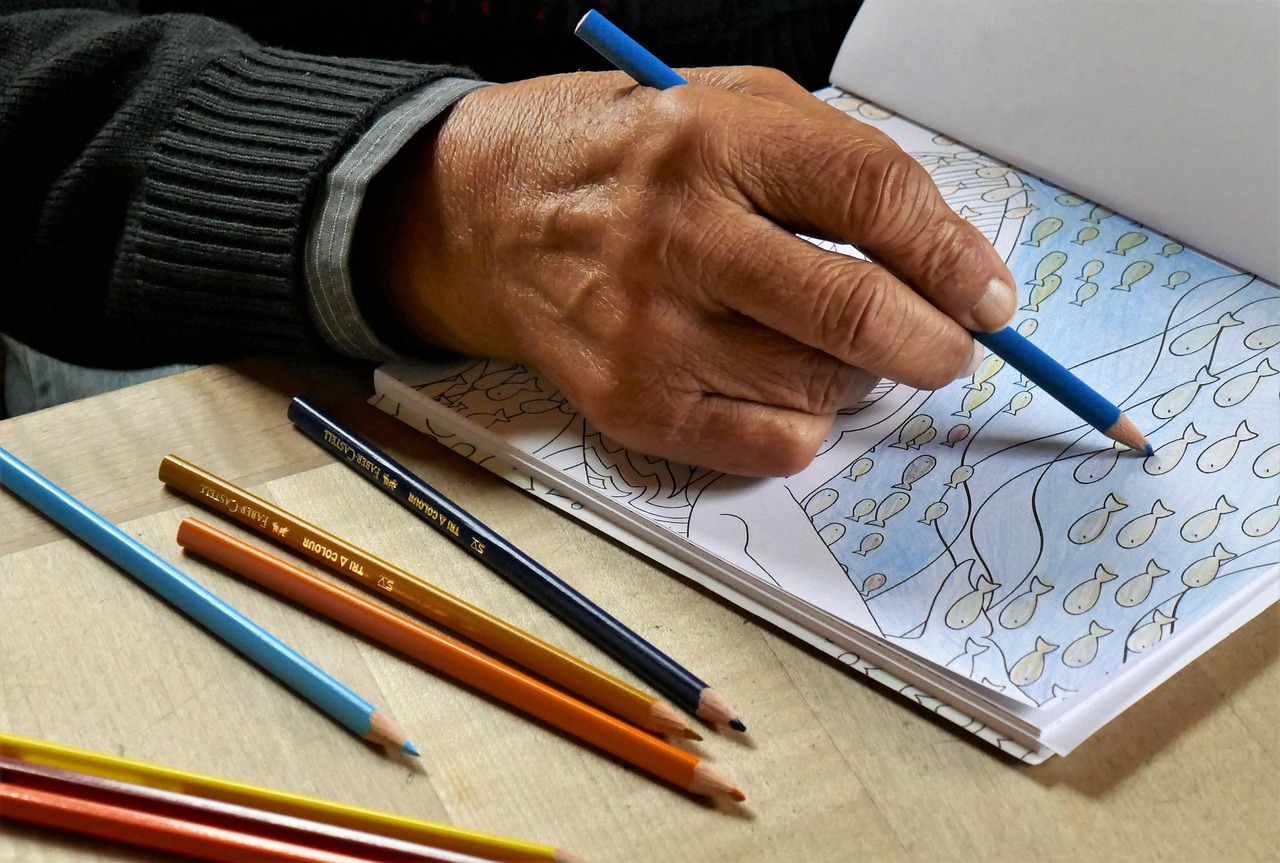
Coloring for relaxation: Coloring books for adults, including calm and seasonal designs, are often marketed as a way to “switch off” and relax. Research does not claim that coloring can treat mental health conditions, but several studies suggest that simple art activities, including coloring, can reduce short-term feelings of stress and anxiety for some people.
What studies say about coloring and anxiety
One early and frequently cited study by Nancy Curry and Tim Kasser investigated whether coloring a mandala (a circular, patterned design) could reduce anxiety in university students. Participants first had their anxiety temporarily increased using a writing task and were then randomly assigned to color either a mandala, a plaid pattern, or a blank sheet for 20 minutes. Anxiety was measured before and after using a standard questionnaire. Students in the mandala condition showed a larger reduction in state anxiety than those in the other two conditions.
A later replication by van der Vennet and Serice used a similar design and again found that coloring pre-drawn patterns (mandalas or other designs) led to significant reductions in anxiety from before to after the activity. In that study, all structured coloring conditions reduced anxiety compared with baseline, suggesting that the general act of focused coloring, rather than one specific design, may be helpful.
More recent work has broadened the picture. A 2020 open-access study on “Coloring Activities for Anxiety Reduction and Mood Improvement” reported that brief coloring sessions in adults were associated with reductions in self-reported anxiety and negative mood compared with control activities.
However, not all findings are straightforward. A 2022 review on mandala coloring and state anxiety concluded that, across multiple experiments, mandala coloring did not consistently outperform free drawing in reducing anxiety, even though both activities often produced short-term improvements.
Beyond coloring specifically, a pilot study on art making more generally (including mandala coloring, painting, collage, and other tasks) found that a single brief art session led to significant reductions in state anxiety in university students compared with a non-art control group.
Taken together, these studies indicate that:
- Short, structured art activities, including coloring, can reduce self-reported anxiety and negative mood immediately after the activity in many participants.
- The specific pattern (for example, mandala versus other designs) may matter less than the combination of structure and sustained engagement.
- Evidence is mainly short-term, often in student samples, and does not show that coloring alone can treat anxiety disorders.
How coloring overlaps with mindfulness
Mindfulness practices train attention to stay with the present moment in a non-judgemental way. Reviews of mindfulness-based interventions show that they can reduce stress and improve aspects of mental health in many groups, although effectiveness depends on the programme and population.
Mindfulness-based art therapy (MBAT) deliberately combines mindfulness exercises with simple art tasks such as drawing, painting, or working with shapes and color. Reviews and recent trials report that MBAT programmes can reduce stress and, in some studies, anxiety and depressive symptoms, while also helping with emotional regulation.
Coloring can be used in a similar way:
- Some interventions instruct participants to notice the movement of the hand, the feel of the pencil on the paper, and the colors chosen, returning attention gently whenever the mind wanders.
- Studies of “mindfulness coloring” protocols in children, adolescents, and university students frame the activity as a short, structured mindfulness exercise linked to exam or test anxiety.
In this context, coloring functions as a concrete, repetitive task that helps anchor attention, similar in spirit to focusing on the breath or on physical sensations during traditional mindfulness practice.
Possible mechanisms suggested in the research
Researchers have proposed several non-exclusive explanations for why coloring and related art tasks might feel calming:
- Distraction from worry: Experimental designs commonly induce anxiety (for example, with a stressful writing task) and then measure reductions after coloring. One interpretation is that sustained attention on shapes and color competes with worry-based thinking.
- Structured but low-pressure choice: Studies comparing structured designs (like mandalas) with free drawing suggest that having some visual guidance can be helpful, possibly because it reduces decision load while still allowing creative choice.
- Flow-like engagement: Research on creative activities links deep, absorbed engagement (“flow”) with reduced negative mood and stress markers. Some coloring studies explicitly measure flow and report that repetitive, absorbing tasks can promote it.
- Physiological stress reduction through art-making: Art-making more broadly has been associated with reductions in stress hormones such as cortisol and improved self-reported stress levels after a single session.
These are proposed mechanisms, not definitive explanations. Most studies rely on self-report scales and short sessions, and there is limited direct evidence about long-term physiological effects of coloring alone.
Practical implications and limits
Across multiple small studies, a consistent pattern appears: brief, structured art tasks such as coloring are associated with immediate reductions in self-reported anxiety or stress for many participants, particularly when people are already feeling tense.
Protocols in the research are usually simple: 15–30 minutes of uninterrupted coloring or art-making, using pre-printed designs or basic materials, often after a stressful induction.
At the same time:
- The evidence base is still developing, with many studies involving small samples and specific groups (often students).
- Coloring has not been shown to replace established treatments for clinical anxiety, depression, or trauma-related conditions. Clinical guidelines continue to prioritise evidence-based therapies and, when appropriate, medication.
For adults who already find calm, structured coloring—whether festive or non-seasonal—subjectively helpful, the current research supports the idea that this kind of focused, creative activity can be one useful short-term strategy for managing everyday stress, alongside other evidence-based approaches.
If you would like to know more, a Mayo Clinic Health System article notes that coloring for relaxation can promote mindfulness and relieve stress